This page is designed to help you keep up to date with the Renters Rights Act 2025. It includes useful resources to help keep you in the know!
Implementation will be phased in three stages to help agents, landlords, and tenants adapt:
Phase 1 will start on May 1, 2026. As we’ve always suspected, this is when the legislation’s big ticket items will become effective, including the abolition of Section 21, the transition to periodic tenancies, rent increases being limited to once per year, and more.
Phase 2 includes the introduction of the PRS database and the landlord ombudsman. The Register Your Rental Property service is due to be launched at the end of 2026 regionally – the North West will start on the 15th of May 2027
Phase 3 will happen from 2030 onwards, including the application of Awaab’s Law and the Decent Homes Standard to the PRS.
Renters Rights Act Eguide
We have put together a handy e-guide, created based on the government roadmap of how they will implement these phases, you can download your copy here.
If you have any questions about this just let us know!
During each phase, there is going to be a number of different changes. To help guide you through these changes, we have put together a selection of short videos that go through each of the major changes, what they mean for you and how we can help prepare you for these changes. Check them out below!
Phase 1 – 1st May 2026
Click the cards below to view each video on Youtube!







The government have released a useful guide on Pet in Lets and what may and may not be considered a reasonable excuse – click here to read it
Update: 21/01/2026
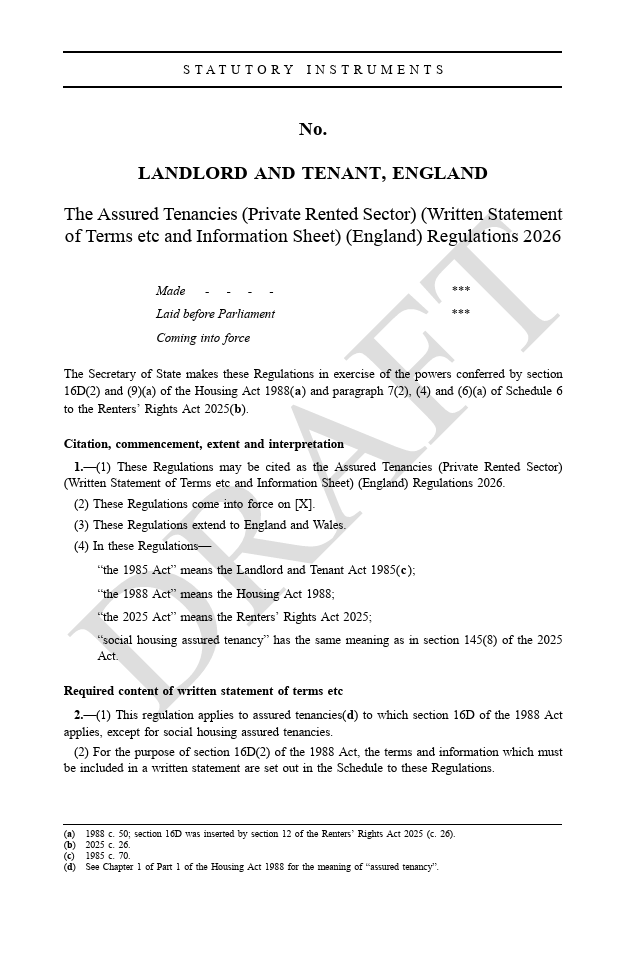
The government have now set out their draft secondary legislation for what needs to be in all tenancy agreements from 1st May 2026. At this point all tenancies must be in written form – whilst is is good practice at the moment, it isn’t strictly required. Check out the video and link to the draft legislation below:
Update 20/03/2026
The government have now released the tenant information sheet which must be given to all current tenancies before the 31st of May 2026. We would recommend providing this in both physical and digital format to ensure your tenants have received it.

Renters Rights’ Evening – Self Managing Landlord
We recently hosted a renter’s rights evening for self managing landlords who need to be taking action now. Check out the recording and slides below:
Slides:
Phase 2 – Late 2026 – 2028
Expected Changes:
Stage 1 – Private Rented Sector Database for Landlords and Properties
A new Register your rental property service will be introduced under phase two of the Renters’ Rights Act. Landlords with assured periodic tenancies will need to register themselves and each property they let, with an annual fee of £65 per property.
For properties in Lancaster, Morecambe and the wider North West, the requirement starts on 15 May 2027. Landlords will have until 14 August 2027 to register. You will need to start the registration yourself, although your letting agent may be able to provide some property information on your behalf. It is worth getting your property details and gas, electrical and energy performance documents ready now. We are currently waiting on further guidance as to what agents will be able to help landlords with – watch this space!
What information will landlords need to provide?
The registration service will ask for details about the landlord, the property and the tenancy.
Landlord and property details
- The property’s house number and postcode.
- The name of the current or intended residential landlord, along with an email address and a correspondence address in England or Wales. A PO Box cannot be used.
- The property type: detached, semi-detached, terraced, flat or other.
- The ownership type: freehold, leasehold, share of freehold or commonhold. This helps councils identify who is responsible for repairs.
- The name and email address of the freeholder, any superior landlord and the property manager, where applicable.
- The number of bedrooms, excluding rooms smaller than 4.64 square metres.
Occupancy and licensing
- Whether the property is currently occupied by tenants.
- The number of households and people living there. Include children, babies and anyone who lives there permanently; exclude short-stay guests, holidaymakers and people whose main home is elsewhere.
- Whether the property needs a mandatory HMO, additional HMO or selective licence, and the licence number if available.
Rent and furnishings
- Whether the property is furnished, part-furnished or unfurnished.
- How often rent is charged and the amount payable. Include any bills or services covered by the rent, but exclude arrears and advance payments.
- Whether bills are included in the rent.
Safety documents
- Whether the property has a gas supply or gas appliances, and its gas safety record where applicable.
- The electrical safety document held for the property: an Electrical Installation Certificate (EIC), an Electrical Installation Condition Report (EICR), or neither.
- The property’s Energy Performance Certificate (EPC). The service will check the EPC register and ask the landlord to confirm the certificate it finds.
Landlords will also need to keep their registration details up to date, including uploading new gas safety and electrical safety documents within the required timeframe – this may be something agents are able to help with.
Stage 2 – Landlord Ombudsman
Provides redress service to tenants when things go wrong. It is expected that this is going to become part of the already existing ombudsman for the social sector.
Supports landlords with tools and guidance
Fee to be charged (TBC)
Further details still to be confirmed on these!
Phase 3 – 2030 Onwards
Expected Changes:
Minimum Energy Efficiency Standards to hit a ‘C’ or as close as possible after a total investment of £10,000 to register for an exemption – still in consultation
A new Decent Homes Standard which will lay out minimum requirements for housing quality
Awaab’s Law will be extended from the social sector to the PRS which will set clear, legally enforceable timeframes for making homes safe where there are serious hazards – particularly in relation to mould
Further details still to be confirmed on these!