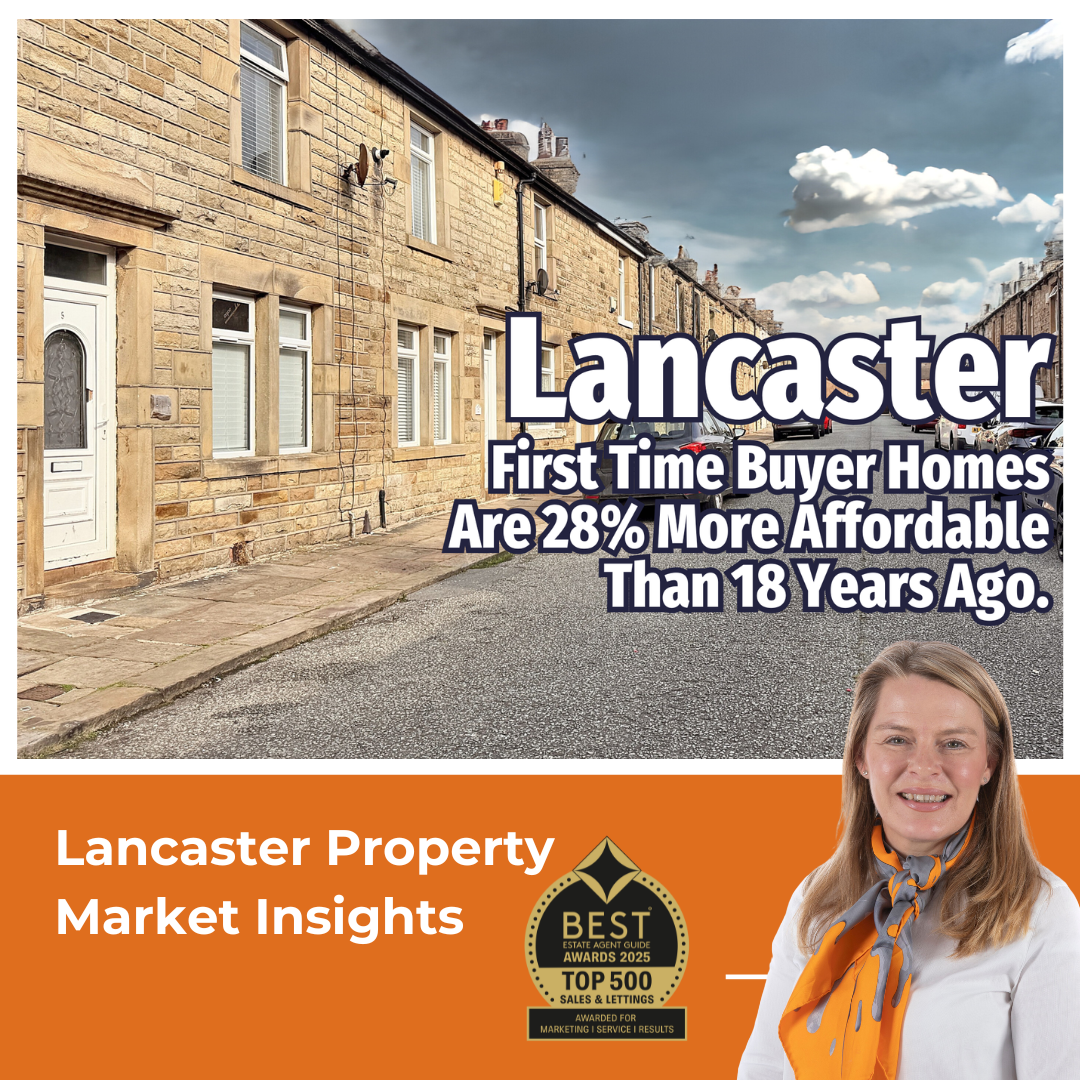
If you listen to the doom-and-gloom headlines, you’d think first-time buyers in Lancaster have no chance at all. We often hear the same sweeping statements – house prices are too high, wages haven’t kept up, and the door to homeownership has been firmly shut. But when you look at what’s actually happening here in Lancaster, the reality is far more encouraging.
Let’s start with the figure that normally surprises people. Since 2007, Lancaster starter homes have risen in value by 39.9%. On the surface, that sounds like a disaster for affordability. Today, the average first-time buyer home in Lancaster sits around £145,000, with an average salary of £24,287. If you stopped there, you’d assume first-time buyers were being squeezed out.
But headline numbers rarely tell the whole story. What really matters is the monthly mortgage payment and how it compares with take-home pay. That’s the true measure of affordability.
And this is where things shift.
Back in 2007, a typical Lancaster first-time buyer household spent 37.9% of its take-home pay on mortgage payments. Today, that figure is 27.1%. That’s a 28% lighter burden than 18 years ago.
If we look even further back, the picture becomes clearer. In 1989, a Lancaster first-time buyer household spent 33% of their take-home pay on their mortgage. So compared with the late eighties, today’s buyers give up almost 18% less of their income to keep a roof over their head.
This hasn’t happened by accident. Real household incomes have risen over time, interest rates—while sometimes uncomfortable—are nowhere near the eye-watering levels of the late eighties, and mortgage terms are now more flexible, often stretching to 30 or 35 years. For context, interest rates in 1989 were almost 15%. It’s difficult to imagine that now.
And Lancaster itself has evolved. Better transport links, new developments, and investment across the district have attracted more young professionals and families. Mortgage products have diversified too. All of this feeds into greater affordability.
There’s another part of this story that rarely gets mentioned – renting is becoming more expensive. For many people, their rent is already close to, or even higher than, what a mortgage would cost. A fixed-rate mortgage offers stability. Rent doesn’t. In Lancaster, that can make homeownership feel surprisingly within reach.
Of course, the toughest hurdle for most first-time buyers isn’t the monthly payment – it’s the deposit.
You’ll often see headlines quoting the “average” first-time buyer deposit. In the North West, that figure currently sits at £42,863. It’s a big number, and understandably, it puts people off before they explore their options.
But this figure is misleading. It reflects choices buyers make to access lower rates or because they have family support. It isn’t the minimum. The minimum deposit is 5%. A 95% mortgage is completely normal and has been for years. Some lenders even offer 100% mortgages to those with especially strong credit histories. So the idea that every Lancaster buyer needs £40,000+ saved is simply untrue.
At the moment, the best 95% five-year fixed deal is around 4.7%, while a 75% mortgage sits closer to 3.8%. Yes, bigger deposits mean better rates, but smaller deposits don’t close the door. Extending the mortgage term can also help keep monthly payments manageable.
And now to the part where many younger buyers quietly sigh: the sacrifice. Saving a deposit today takes real discipline, and it’s important to acknowledge why it feels harder. The world is a very different place to what it was in the 1980s. Back then, the cost of owning a mobile phone didn’t exist. Most households didn’t have two cars. And there was no internet offering daily temptations to spend—no next-day delivery, no subscription services, no adverts following you around your phone. We had to think before we spent because spending required effort. Simply put, it was easier to save because there was far less temptation. Today’s buyers face challenges previous generations simply didn’t.
And this is why the numbers matter. Because once that deposit hurdle is overcome, the monthly affordability of owning a home in Lancaster is far better than many people expect. And unlike renting, every payment builds equity—something that pays you back in the long run.
Buying your first home in Lancaster may be challenging, but it is absolutely possible. The facts show it. And for many people, knowing that the door isn’t closed is the first step toward walking through it.
Are you a first-time buyer? Would you like to chat about your options and how we can guide you? My name is Michelle Gallagher and at JDG EState Agents we are here to help.
Thanks for reading
Michelle x